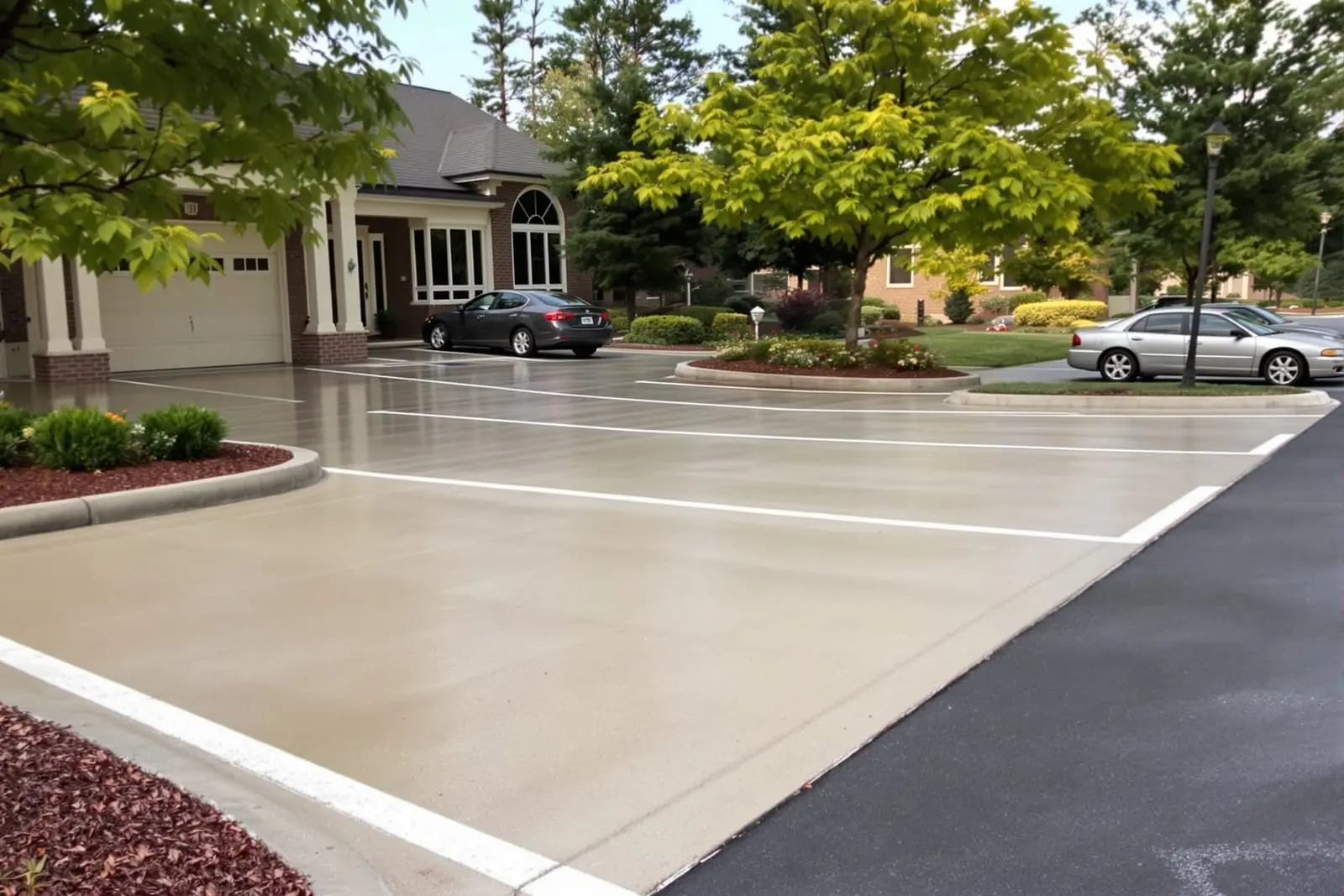
Give customers and employees a stable surface with concrete parking lots in Pittsburgh, PA. We design and pour lots sized for your traffic and drainage needs. From new construction to replacements, our concrete parking lots are reinforced to handle vehicles and reduce long term maintenance.
Brava Concrete Pittsburgh provides professional concrete parking lot throughout Pittsburgh, PA and the surrounding area. Our licensed, insured crew delivers safe, clean, on-time work with a free estimate before anything begins. Call (412) 231-9528 or request your free quote.
Durable Concrete Parking Lots for Pittsburgh Businesses
If customers and employees are driving onto your property every day, the concrete parking lot they use has to hold up to weight, weather, and winter plowing. Brava Concrete Pittsburgh focuses on parking lot concrete that is designed specifically for Western Pennsylvania conditions, not a one-size-fits-all approach.
Our crew handles new concrete parking lot installations, tear out and replacement of failed asphalt or concrete, and expansions when you need more parking. We start by walking the site with you, looking at traffic patterns, delivery truck routes, drainage problems, and ADA access. A lot that serves a medical office in Shadyside needs different layout details than a trucking yard in the Strip District, and we plan accordingly.
Because Pittsburgh gets freeze-thaw cycles, snow, road salt, and heavy rain, we use air-entrained concrete mixes and proper joint layouts to reduce cracking and spalling. We also look at how the lot ties into city sidewalks, alleys, and existing drive aprons so you stay compliant with local codes and avoid standing water where pedestrians walk. The goal is a concrete parking lot that works all year and does not become a maintenance headache after a couple of winters.
How We Build a Concrete Parking Lot That Lasts
A long lasting concrete parking lot starts underneath the slab. Brava Concrete Pittsburgh begins by stripping any old asphalt or broken concrete, then proof rolling the exposed subgrade to find soft spots. Any pumping or deflection under the roller tells us where soil needs to be undercut and replaced with compacted stone. Skipping this step is a common reason lots settle and crack.
Once the subgrade is stable, we install a crushed stone base, typically 4 to 8 inches depending on traffic loads and soil conditions. In areas with clay or poor drainage, such as many Pittsburgh hillsides, we may use a thicker base and add underdrains that daylight to storm inlets or daylight points so water cannot sit under the slab. Every lift of stone is mechanically compacted to reach the required density.
Formwork defines the edges, curbs, and any islands. We set elevations carefully to pitch water toward catch basins or swales, aiming for consistent slopes that drain but still feel comfortable to walk and push carts on. Before concrete is placed, we install welded wire fabric or rebar reinforcement in key areas, such as drive lanes, dumpster pads, loading zones, and any areas where trucks turn sharply.
Concrete is then poured from ready mix trucks, placed with rakes and screeds, and finished using power trowels where appropriate. For parking lots we prefer a broom finish, which gives better traction in rain and snow compared to a slick troweled surface. Control joints are cut to a planned pattern and depth, usually within 6 to 12 hours, so that if concrete does crack, it does so in neat, straight lines instead of randomly across the pavement. Finally, we cure the slab using curing compound or wet curing methods, which is critical for strength and reducing surface dusting.
Options, Design Details, and What Affects Cost
No two concrete parking lots cost the same, even if they look similar in size. Brava Concrete Pittsburgh walks you through the design choices that actually drive the final price so you understand where your money is going.
The biggest factors are thickness, base depth, and reinforcement. A basic car-only lot might use a 5 inch slab over a 4 inch stone base with mesh, while a plaza that gets frequent box trucks or garbage trucks at the loading dock might need 6 to 8 inches of concrete with rebar and a thicker base. Heavy use areas can be thickened slabs tied into footings. It costs more up front, but it typically avoids rutting and corner breaks that lead to patch after patch.
Drainage work is another cost driver. If your property in Pittsburgh slopes steeply or has known drainage issues, we may need to install additional catch basins, trench drains at building entrances, or tie into existing storm lines. We design slopes to keep water moving without directing it toward neighboring properties, which helps reduce liability and meet local requirements.
Finish and appearance options also play a role. Standard gray broom finish is the most economical, but we can add integral color for designated areas, sawcut decorative joints near building entrances, or thicker curb details around islands. For sites that see a lot of winter plowing, we recommend simple, durable layouts with wide radiuses so plows do not chip corners.
Access logistics matter in Pittsburgh too. Tight city lots, limited staging areas, or work that has to happen off-hours to keep a business open can increase labor. If concrete must be pumped instead of discharged directly from the truck, that equipment and crew time factor into the quote. By walking the site in person, we can give realistic pricing, not a guess that changes later.
Common Concrete Parking Lot Problems and How We Prevent Them
Many property owners call Brava Concrete Pittsburgh after dealing with potholes, broken edges, and ponding water in lots that are only a few years old. These problems are not unavoidable. They usually come from shortcuts in base prep, poor drainage planning, or the wrong concrete mix for this climate.
One frequent issue is standing water. If a lot was poured flat or without enough slope to catch basins, puddles will sit, freeze, and eventually break down the surface. We prevent this by using laser levels and string lines to set consistent, gentle slopes during formwork. In some cases we recommend reshaping an existing base to correct bad drainage before placing new concrete.
Another common problem is edge damage where delivery trucks ride up over the side of the pavement. We address this by thickening edges in truck paths, tying in curb details, or adding bollards and wheel stops to control vehicle movement. For dumpster pads and loading areas, we often isolate thicker reinforced slabs so the highest loads are supported independently from standard parking stalls.
In Pittsburgh winters, scaling and surface flaking can show up if the wrong concrete mix is used or if deicing salts are mismanaged. We specify air-entrained mixes and proper curing procedures to resist salt and freeze-thaw cycles, and we share maintenance guidance with you so your staff or snow contractor does not unintentionally shorten the life of the lot.
Joint spalling and random cracking are also frequent complaints. Our approach is to design a joint layout based on panel size, shape, and reinforcement, then cut or tool those joints at the right time. We keep panels as close to square as possible and coordinate joint locations with striping so visual lines make sense to drivers and pedestrians.
What Pittsburgh Property Owners Should Know Before Hiring
Before you invest in a concrete parking lot, there are a few key questions to ask any contractor who bids your job. Brava Concrete Pittsburgh encourages you to ask these same questions of us because they highlight the things that actually protect your investment.
Ask how they handle subgrade evaluation and compaction. You want a clear plan for dealing with soft spots, not just a promise of a 4 inch stone base. Ask what thickness and reinforcement they are proposing in each area of the lot, especially where trucks, delivery vans, or emergency vehicles will travel or park. A single global thickness listed on a bid can be a red flag if your use is more demanding in certain zones.
Clarify who designs drainage and slope. In Pittsburgh, you may need to respect existing storm tie-ins, alleys, and sidewalks. A good contractor will talk about slope percentages, possible need for additional inlets, and how water will move during heavy rains. They should be able to explain this in plain language on site, not just show you a line on paper.
You should also understand the project schedule and access plan. We frequently phase work so parts of a lot can remain open, or schedule pours early in the morning or on weekends to avoid disrupting operations. Discuss how long areas must stay closed for curing, and how traffic will be rerouted during each pour.
Finally, ask about warranties and maintenance. A realistic warranty on workmanship, along with specific guidance on sealing, snow removal, and deicer use, shows that the contractor expects the concrete parking lot to last. Brava Concrete Pittsburgh is happy to walk the lot with you after completion, point out joint locations, and outline a simple maintenance plan so you know exactly how to protect your new investment.
“
Professional parking lot concrete, done right the first time, quality materials, honest pricing, and results that last.