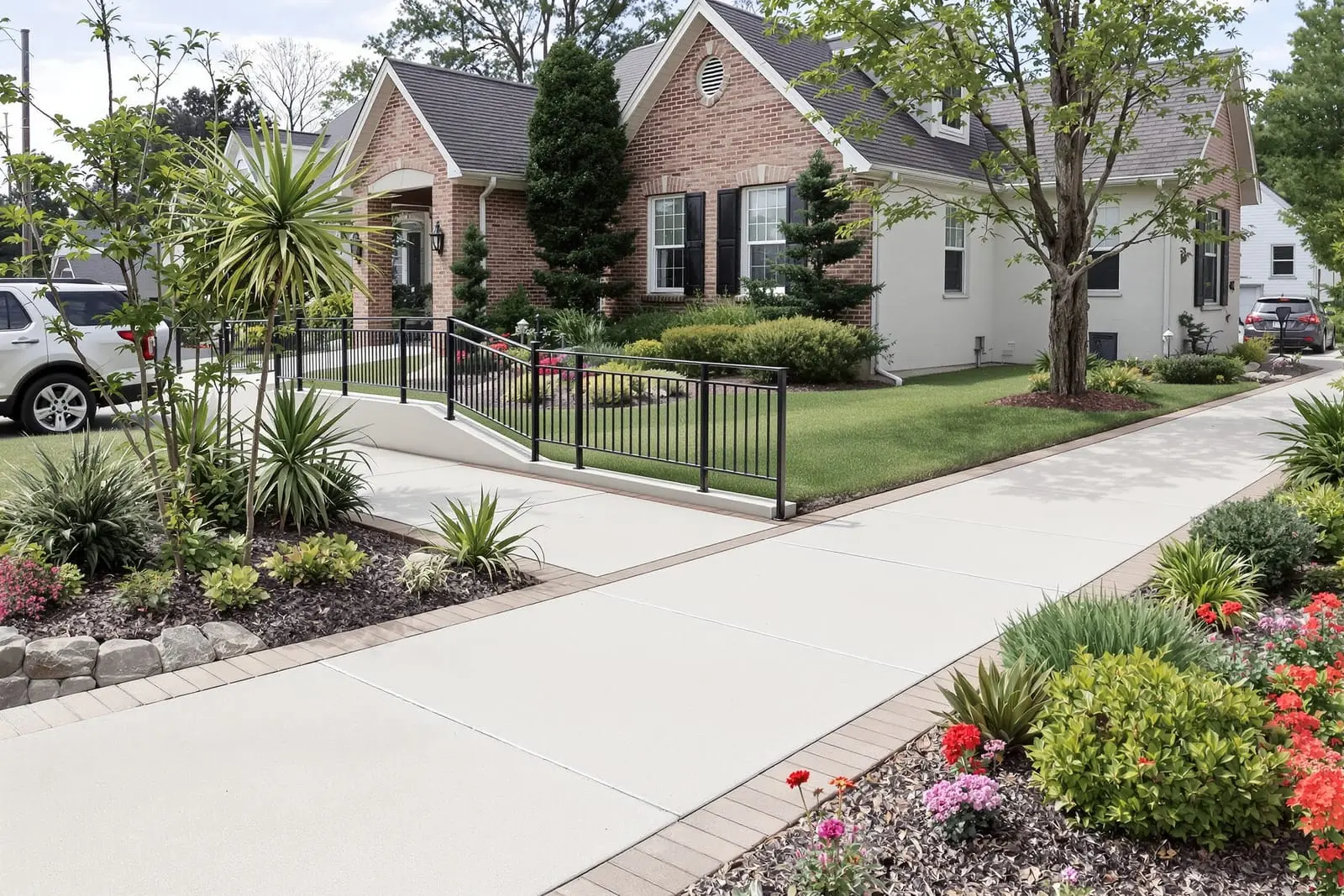
Provide safe access for visitors with commercial sidewalk installation in Pittsburgh, PA. We build wide walks and ADA compliant concrete ramps that meet code requirements. Our installations tie into entrances, parking lots, and public sidewalks with proper slopes and surface textures.
Brava Concrete Pittsburgh provides professional commercial sidewalk installation throughout Pittsburgh, PA and the surrounding area. Our licensed, insured crew delivers safe, clean, on-time work with a free estimate before anything begins. Call (412) 231-9528 or request your free quote.
Commercial Sidewalks & ADA Ramps for Pittsburgh Properties
Brava Concrete Pittsburgh designs and installs commercial sidewalks and ADA-compliant ramps for businesses, municipalities, schools, healthcare facilities, and multifamily properties throughout the Pittsburgh area. Our focus is on safe pedestrian access, long service life in local freeze-thaw conditions, and clean, professional appearance that matches your site.
Allegheny County inspectors and national brands expect concrete work that meets ADA, IBC, and local municipal standards. We build every commercial sidewalk installation and ramp project to these codes from the start, so you are not paying for rework later. Our crews handle new construction, replacements tied to tenant improvements, and targeted corrections to resolve ADA violations or trip hazards.
If you manage a storefront in Lawrenceville, a medical office near UPMC, or an industrial site by the rivers, we tailor layout, thickness, and reinforcement to your expected foot traffic, delivery routes, and snow control methods. The result is a system that holds up to salt, plows, and utility access without constant patching.
How We Plan Your Sidewalk and ADA Ramp Project
A successful commercial sidewalk installation in Pittsburgh starts with careful site planning. Brava Concrete Pittsburgh begins with a walk-through to evaluate existing grades, drainage patterns, doorway thresholds, and connection points to public walkways or parking lots. We look for current issues like ponding water, heaved slabs from tree roots, or steep transitions from asphalt to concrete.
Our team measures and documents slopes, cross slopes, and elevation changes so we can design ADA-compliant routes that actually work in daily use. For ramps, we map out available run length, landings, and turning areas to maintain maximum 1:12 running slope and 1:48 cross slope. Where hills or tight spaces in Pittsburgh neighborhoods make that difficult, we may propose switchback ramp configurations or small regrading to stay compliant.
We coordinate with you on access staging so your building stays operational. For example, retail storefronts on narrow city sidewalks often require phased work that keeps at least one safe access point open at all times. For medical or senior facilities, we schedule work during lower traffic hours and always maintain at least one ADA-compliant route for patients and staff.
Materials, Thickness, and Reinforcement Choices
Pittsburgh’s freeze-thaw cycles and deicing salts are tough on exterior concrete, so material selection matters. Brava Concrete Pittsburgh typically specifies 4,000 to 4,500 psi air-entrained concrete for commercial sidewalk installation and ADA ramps. Air entrainment provides microscopic pockets that help relieve pressure when trapped water freezes, which significantly reduces surface scaling.
Standard commercial sidewalks are often placed at 4 inches thick. Areas that see heavier loading, such as delivery zones, dumpster pads adjacent to walkways, or fire lane crossings, may go to 6 inches or more. We install welded wire mesh or rebar where traffic loads, poor subgrade, or frequent freeze-thaw cycles justify the extra reinforcement.
Finishes are also intentional. Most sidewalks and ramps receive a broom finish oriented perpendicular to walking direction for traction, which is important for wet and icy conditions in Pittsburgh winters. We often include integral color bands or sawcut patterns at crosswalks or entrances to guide pedestrians and improve visibility.
Where utilities pass under sidewalks or in high-maintenance areas, we may propose thicker slabs with doweled joints, or provide conduit sleeves so future work does not require breaking large sections of concrete.
Building ADA-Compliant Ramps, Landings, and Detectable Warnings
True ADA compliance involves more than placing a short ramp at a curb. Brava Concrete Pittsburgh designs complete accessible routes from parking or sidewalk to the building entrance or tenant space. This includes slopes, landings, transitions, and handrails when required.
We design ramps with consistent slopes, no unexpected dips or humps, and landings that are level and large enough for wheelchair turning. At doorways, we manage the relationship between finished floor height, threshold, and exterior concrete so water is managed without creating a vertical lip that violates ADA.
For curb ramps that tie into public sidewalks or municipal streets, we follow local Pittsburgh and PennDOT standards. Detectable warning surfaces (truncated dome panels) are installed at curb ramps where pedestrians enter vehicle ways. We choose panel materials and anchoring methods that hold up to plow blades and salt. Layout is coordinated with crosswalk striping so visually impaired users follow a predictable, straight path.
We also pay attention to edge protection on raised walkways and ramps. Where there is a drop-off, we incorporate curbs or wheel stops as required, and coordinate handrail placement with your architect or code consultant when needed.
Typical Installation Process on Pittsburgh Sites
Once design is approved and permits are in place, Brava Concrete Pittsburgh follows a structured installation process that minimizes disruption and supports long-term performance.
First, we handle demolition and removal of existing concrete or asphalt. We cut clean edges at tie-in points, remove deteriorated sections with breakers or saws, and haul debris to an appropriate recycler or disposal site. We then shape and compact the subgrade, adding a crushed stone base when necessary to improve drainage and support.
Next, we set forms that define slopes, widths, and edges of sidewalks and ramps. At this stage we verify slopes with levels and digital inclinometers to ensure ADA compliance before any concrete is poured. We install reinforcement (mesh or rebar) and expansion joints at building interfaces, utility structures, and long runs.
Concrete is then placed, consolidated, struck off, and finished. In Pittsburgh’s variable weather, we monitor temperature and wind to time finishing and curing correctly. Control joints are sawcut or tooled at calculated spacing to manage cracking. After final finishing, we apply curing methods (often a curing compound) to protect against rapid moisture loss.
Finally, we remove forms, backfill edges, and restore disturbed areas such as turf or landscaping. We schedule striping, detectable warning installation, and any railings so the full accessible route is ready for inspection and public use.
Seasonal Timing, Weather Challenges, and Curing
Western Pennsylvania weather heavily influences commercial sidewalk installation timing and method. Brava Concrete Pittsburgh typically recommends larger exterior concrete projects between late spring and mid fall, when daytime and nighttime temperatures support proper curing and there is less risk of snow or ice.
However, commercial work often cannot wait. In colder months, we adjust mix designs, use insulating blankets, and sometimes heated enclosures to keep concrete in the proper temperature range during the first critical curing days. We avoid placing concrete on frozen subgrades or when rapid temperature drops are forecast, which helps prevent early-age cracking and surface scaling.
Summer work requires its own planning. High heat and direct sun can cause rapid moisture loss and plastic shrinkage cracking. We adapt placement times, use evaporation reducers when needed, and ensure prompt curing application. For high-visibility entrances, we plan pours early in the day to reduce customer interruption and take advantage of more stable temperatures.
Pittsburgh’s frequent freeze-thaw cycles and road salt use mean you should not apply deicers to new concrete for the first winter whenever possible. We educate building managers and maintenance staff about using sand instead of salt on new sidewalks and ramps to improve snow safety without damaging the surface prematurely.
Costs, Permits, and What Impacts Your Budget
Project cost is shaped by more than just square footage. Brava Concrete Pittsburgh provides itemized proposals so you see exactly how each choice affects budget. Factors include thickness (4 inch versus 6 inch or more), reinforcement type, removal of existing materials, subgrade correction, and complexity of ADA ramp geometry.
Site access is another major driver. Work in tight Pittsburgh neighborhoods, downtown corridors, or on busy commercial sites may require more manual labor, phased work, traffic control, or off-hours scheduling. Similarly, tying into municipal sidewalks or curbs can involve city permits and specific details that add to time and cost.
Permitting varies by municipality around Pittsburgh. For many curb cuts, public sidewalk tie-ins, or work in the right-of-way, permits and inspections are mandatory. Our team helps coordinate with local authorities, provides any required drawings or details, and schedules inspections so your project passes cleanly the first time.
Before you request bids, it helps to clarify where you want accessible routes, which entrances must be ADA compliant, and any future expansions you anticipate. With that information, Brava Concrete Pittsburgh can propose a layout that avoids relocating freshly poured concrete later and delivers long-term value rather than short-term patches.
“
Professional commercial sidewalks & ada ramps, done right the first time, quality materials, honest pricing, and results that last.
Brava Concrete Pittsburgh
Commercial Sidewalks & ADA Ramps Across Our Service Area