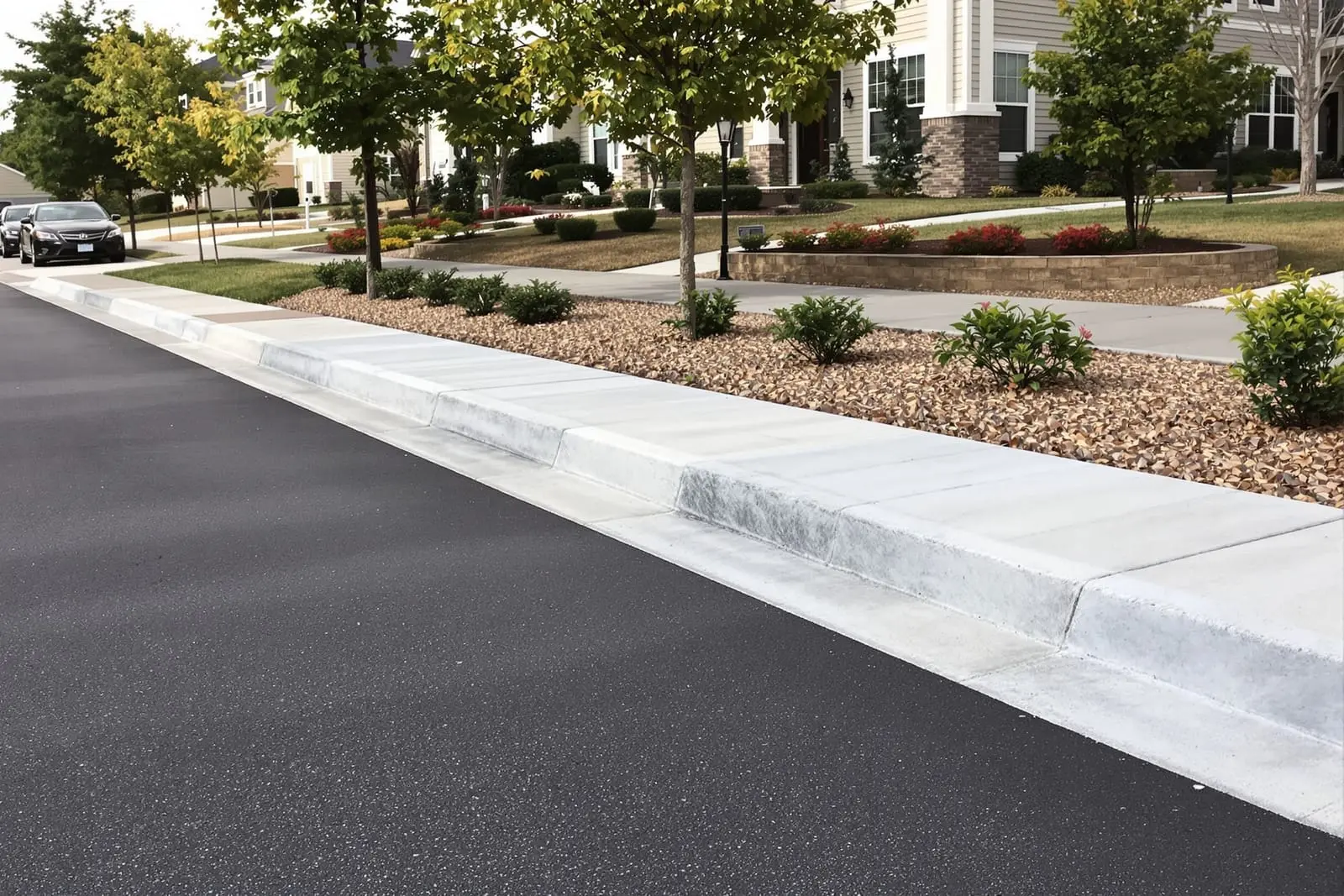
Control traffic and water with concrete curbs and gutters in Pittsburgh, PA. We install formed and machine placed curbs for parking lots, roads, and site work. Our team also builds concrete barriers that protect structures, direct vehicles, and meet your site layout needs.
Brava Concrete Pittsburgh provides professional concrete curb and gutter throughout Pittsburgh, PA and the surrounding area. Our licensed, insured crew delivers safe, clean, on-time work with a free estimate before anything begins. Call (412) 231-9528 or request your free quote.
Concrete Curb and Gutter Specialists in Pittsburgh
Brava Concrete Pittsburgh builds and repairs concrete curb and gutter systems that actually work with our city’s streets, hills, and weather, not against them. From tight city lots in Lawrenceville to wider suburban drives in Robinson and Monroeville, we design each curb, gutter, and barrier to control water, protect pavement edges, and stand up to freeze and thaw cycles.
When we visit your property, we start by walking the site with you. We look at existing grading, where water currently ponds or runs, nearby storm inlets, and how vehicles use the space. A curb and gutter on a steep Mount Washington driveway needs different dimensions and reinforcement than a gentle approach in Fox Chapel. We measure slopes with levels or laser equipment so the gutter has enough fall to move water without creating trip hazards.
Our work includes residential driveway aprons, commercial parking lot perimeters, industrial loading areas, and municipal style curb lines. In each case, Brava Concrete Pittsburgh focuses on how the curb and gutter interacts with your asphalt, sidewalk, or building entrances so you get a complete system, not just a strip of concrete poured and forgotten.
How Proper Curbs and Gutters Protect Your Property
Concrete curbs and gutters are more than a neat edge. A correctly designed system keeps runoff away from foundations, prevents undermining of asphalt, and reduces heaving and cracking from trapped water that freezes in winter. This is especially important around older brick and stone homes in neighborhoods like Squirrel Hill and Shadyside where foundations are shallow and drainage can be tricky.
The curb itself holds your pavement in place so it does not ravel or break at the edges under vehicle load. The gutter channel collects water and directs it to a swale or storm drain. In Pittsburgh, common issues we see are standing water along the edge of driveways, soil washing across sidewalks, and ice sheets forming near garage doors. Many of these problems trace back to a missing or poorly sloped curb and gutter.
Brava Concrete Pittsburgh designs each curb profile and gutter slope to match how you actually use the space. For example, a commercial site that sees delivery trucks may require a heavier duty curb with thicker concrete and more steel, while a residential curb near a garden might use a lower profile so it is easier to step across while still catching runoff. By tuning these details, we extend the life of your pavement and improve safety year round.
Our Step by Step Installation Process
A long lasting concrete curb and gutter starts with careful layout and base work. First, Brava Concrete Pittsburgh marks the line and grade using string lines and pins or laser levels. We check elevations at several points to ensure the gutter will drain, usually targeting a minimum slope of about 1 percent unless the site requires more. Any soft or organic soil is removed and replaced with compacted crushed stone or gravel to prevent future settlement.
Next, we install forms for the curb and gutter. For standard Pittsburgh residential work, we often use a combined curb and gutter section formed in place, with the curb face, top, and gutter pan all shaped with wood or steel forms and specialized curb tools. Anchor stakes hold everything tight while we double check line and grade before any concrete is placed.
We then pour ready mix concrete, usually a 4,000 psi mix or higher, rated for freeze and thaw conditions and air entrained to resist salt and deicing chemicals. Our crew rods and vibrates the concrete to remove air pockets, then shapes the curb and gutter using hand tools. Control joints are installed at regular spacing to help control cracking. For longer runs, we integrate rebar or dowels at transitions to driveways and existing slabs.
Finishing comes next. For curbs and gutters, we typically apply a light broom finish on the gutter surface for traction and a smooth or slightly brushed finish on the curb face. We round exposed edges to reduce chipping. Finally, we apply curing compound or wet curing methods so the concrete gains strength slowly and evenly, which is critical in our fluctuating Pittsburgh spring and fall temperatures.
Concrete Barriers, Wheel Stops, and Protective Edges
In addition to standard curb and gutter, Brava Concrete Pittsburgh installs concrete barriers and vehicle control features where you need extra protection. These can include vertical or sloped barriers at the edge of parking lots, thicker curb sections at loading docks, and reinforced edges near retaining walls or steep drop offs.
On many commercial sites near busy corridors like McKnight Road or Route 51, we design barrier curbs that prevent vehicles from overhanging sidewalks or striking building facades. These might be integrated with your gutter or installed as separate elements pinned into a reinforced slab. For industrial yards and warehouse sites, we can thicken the curb and add more rebar to handle impact from forklifts or trucks.
For residential properties, we often install compact wheel stops or mini barriers near property lines so vehicles do not creep onto lawns or utility easements. Our approach is to match barrier height and shape to how people actually drive and park, rather than relying on a one size template. Everything is sized and reinforced based on realistic loads and the underlying subgrade quality.
Design Options, Materials, and Pittsburgh Specific Considerations
Although curbs and gutters might look simple, there are real choices that affect performance and appearance. Brava Concrete Pittsburgh works with you on curb height, face shape, and alignment details. Standard curbs might be 6 inches high, but in areas with frequent plowing or where pedestrians step frequently, we may recommend a slightly different height or a sloped reveal to balance visibility and comfort.
Concrete mix design matters in Pittsburgh. We favor air entrained mixes and sometimes use supplementary cementitious materials like slag cement, which is common in our region, to improve durability and resistance to road salt. For high visibility sites, we can add integral color or use a tinted sealer to distinguish curbs from driving lanes. This is useful in large parking facilities near the stadiums or hospitals where clear traffic separation is important.
We also account for how snow plows will interact with your curbs. Tall, sharp edges can chip quickly if plow blades ride too close. For commercial properties with regular plowing, we may suggest a more gradual curb profile and reinforced toe to resist impact. In older city neighborhoods where storm inlets may not be ideally located, we sometimes design custom gutter transitions or small concrete swales to bridge the gap between your private drainage and the public system.
What Affects Cost and Common Problems We Solve
Property owners often ask why curb and gutter pricing varies from one site to another. The main drivers are access, length, required depth and thickness, base conditions, and how much demolition is needed. Removing old, thickened concrete or asphalt in tight city alleys takes more time and disposal than working on an open lot in Cranberry or Bridgeville. Unstable or wet soils near hillside properties may require deeper excavation and more stone.
Brava Concrete Pittsburgh explains these factors upfront. For example, if we discover during excavation that an old stone drain or clay pipe is failing beneath your proposed gutter line, we will show you the issue and discuss repair options before we place any concrete. Addressing subgrade problems early usually costs less than repairing settled or broken curbs later.
Common problems we regularly fix include gutters that back pitch toward garages, curbs that are too low to control water, and sections that have broken off at driveway transitions. Often these issues come from improper slopes, lack of joints, or inadequate compaction under the concrete. Our repairs involve saw cutting clean edges around failed areas, rebuilding the base correctly, tying into sound adjacent concrete with rebar dowels, and then re pouring to proper grade.
We also help customers deal with code or inspection issues, such as when a municipality requires a standard curb section at a new driveway cut. We are familiar with typical local requirements and can coordinate dimensions and locations so your project passes inspection without extra trips and delays.
What to Expect When You Hire Brava Concrete Pittsburgh
When you contact Brava Concrete Pittsburgh about concrete curb and gutter or barriers, we start with a conversation about how your property functions in real life. We ask where you see water after a storm, who parks where, how delivery trucks move, and whether you have had ice or erosion problems in the past. That information shapes our layout and design so we are solving the right problems.
Next, we provide a clear written proposal describing lengths, thicknesses, curb profiles, mix strength, and any reinforcement, along with how site access and restoration will be handled. Before work begins, we call for utility locates and set a schedule that fits around your operations as much as possible. For businesses, we can phase work so sections remain open while others are being replaced.
During construction you can expect some noise, dust, and short term disruption, but we keep the site organized and safe, with clear barricades and signage around fresh concrete. We typically recommend keeping vehicles off new curbs and gutters for at least 5 to 7 days, depending on weather, and avoiding deicing salts on new concrete for the first winter if possible. After completion, we walk the project with you, check drainage performance with a hose test if needed, and review basic maintenance, such as keeping gutter lines clear of debris so water can reach the intended outlets.
“
Professional curbs, gutters & concrete barriers, done right the first time, quality materials, honest pricing, and results that last.
Brava Concrete Pittsburgh
Curbs, Gutters & Concrete Barriers Across Our Service Area