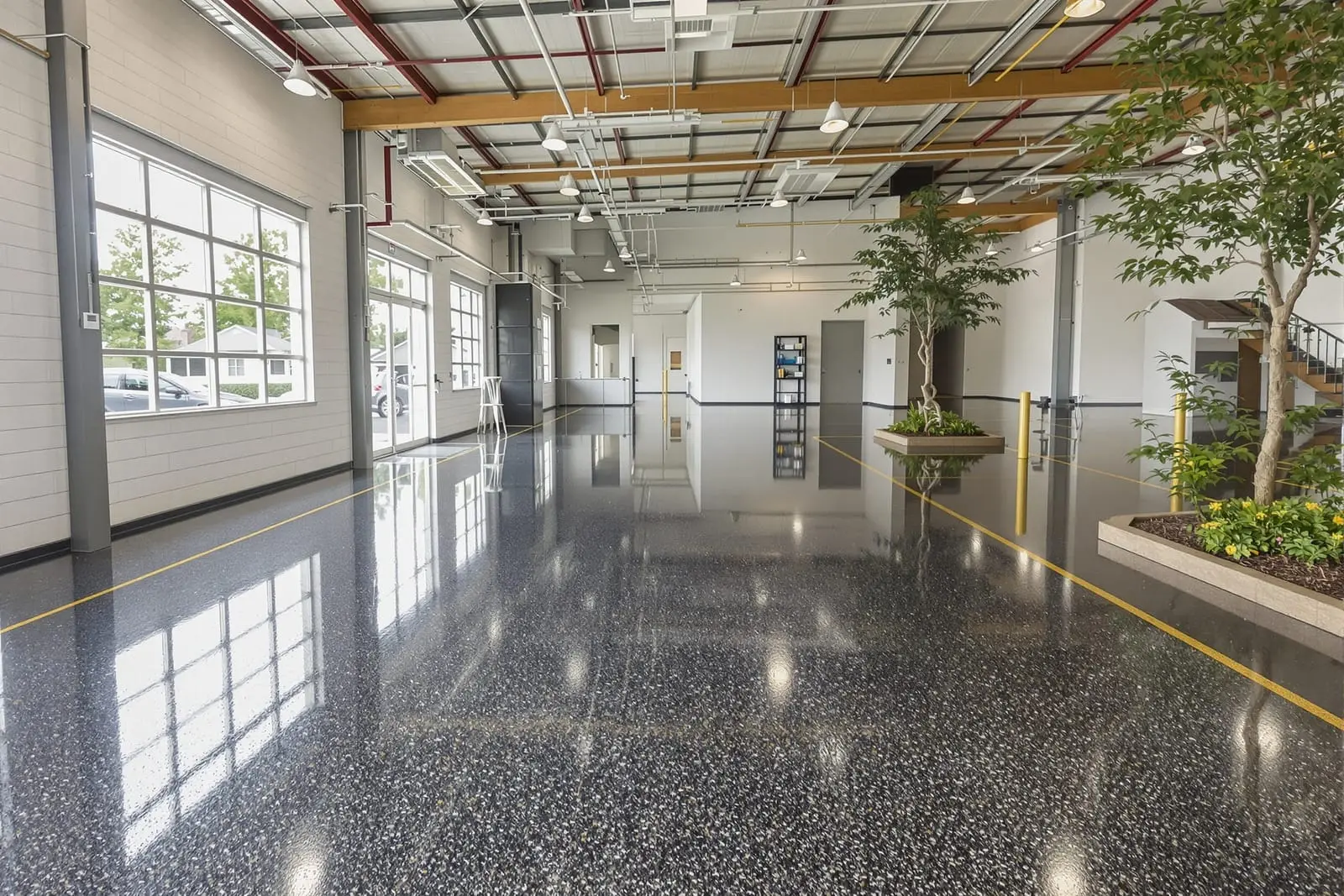
Support equipment and inventory with industrial concrete floors in Pittsburgh, PA. We pour and finish warehouse slabs engineered for forklifts, racks, and heavy loads. Our floors emphasize flatness, durability, and joint layout that works with your operations and maintenance plan.
Brava Concrete Pittsburgh provides professional industrial concrete floors throughout Pittsburgh, PA and the surrounding area. Our licensed, insured crew delivers safe, clean, on-time work with a free estimate before anything begins. Call (412) 231-9528 or request your free quote.
Industrial Concrete Floors Built for Pittsburgh Warehouses
Warehouse and industrial concrete floors have to do more than look smooth. They carry forklifts, pallet racks, dock traffic, and sometimes chemical exposure, all while staying flat and safe. At Brava Concrete Pittsburgh, we build floors for local facilities that handle real-world abuse: steel distribution, food storage, light manufacturing, machine shops, and logistics centers across Allegheny County and the surrounding industrial parks.
Our crews understand the specific conditions around Pittsburgh, such as freeze-thaw cycles, tracked-in road salt from loading docks, aging mill buildings with uneven substrates, and moisture rising from older slabs. We engineer each floor for the loads and use of your space, whether that means super-flat aisles for high-bay racking, heavy point loads under machinery, or a dense, easily cleaned surface for food or pharmaceutical storage.
From cutting out and replacing failed panels in an existing facility to pouring 50,000 square feet of new industrial concrete floors in a ground-up warehouse, Brava Concrete Pittsburgh focuses on durability first, appearance second. You get a floor that stays serviceable, safe, and cost-effective to maintain over the long term.
Planning Your Warehouse or Industrial Floor
The most important work on an industrial concrete floor happens before the concrete truck ever arrives. We start every project with a site visit to measure, test, and ask detailed questions about how your warehouse operates.
We look at slab thickness and reinforcement that match your loads. For a typical Pittsburgh distribution warehouse with standard pallet racking and forklifts, a 6 inch slab with correctly designed joints and reinforcing is often appropriate. For heavy equipment, racking legs with high point loads, or mezzanine columns, we may increase thickness, adjust mix design, or integrate rebar grids and dowel baskets at joints.
We also review your traffic patterns. If you run very narrow aisle forklifts, we may recommend a flatter floor with tighter tolerances and a specific finishing process. If you have constant wet wash-downs or product spills, we might plan slopes to drains and a more slip-resistant finish.
Soils and subbase conditions in Western Pennsylvania vary a lot, especially in reclaimed industrial sites and hilltop warehouses. We check for soft spots, organic fill, and poor drainage. Where needed, we specify proof rolling, soil stabilization, or thicker compacted stone to prevent settlement that can cause slab cracking and joint faulting later.
Before pricing, Brava Concrete Pittsburgh also verifies any requirements from your engineer, landlord, or corporate standards so you do not end up with a floor that fails an inspection after it is already poured.
How We Build Strong, Flat Industrial Concrete Floors
On installation day, our work follows a disciplined sequence that is tailored to industrial concrete floors, not residential patios.
Subgrade and base: We begin by grading and compacting the subgrade to the correct elevation, then installing and compacting a stone base with the moisture content and density verified. This base is critical to prevent pumping at joints under forklift traffic. Where moisture is a concern, such as below warehouse freezers or on previously wet sites along the rivers, we can add vapor barriers and drainage solutions.
Forming and layout: Next, we set forms and layout control points for floor elevation and flatness. If you need super-flat or defined traffic floors for high-bay racking, we use tighter elevation controls and additional checks during the pour. We also plan construction and control joint locations so aisles and rack layouts are not interrupted by problematic joints.
Mix and placement: Brava Concrete Pittsburgh works with local ready-mix suppliers to use industrial-grade mixes, usually 4,000 to 5,000 psi, with low water-cement ratios and proper aggregates. We may add fibers or additives for shrinkage control, freeze-thaw durability, or chemical resistance depending on your use. During placement we use laser screeds or straightedges suited to the slab size to achieve target flatness.
Finishing: After screeding, our crews bull float, then power float and power trowel the surface to the level of smoothness your operation needs. For dry storage and forklift traffic we usually deliver a hard, dense, troweled finish. For wet or sloped dock areas we can leave a slightly more textured finish to improve traction. We finish edges and columns carefully because these are the first places that usually spall if rushed.
Curing, Joints, and Long-Term Floor Performance
The difference between a mediocre warehouse floor and a long-lasting one is often in curing and joint treatment. Brava Concrete Pittsburgh treats these steps as essential, not optional.
Proper curing: We apply curing compounds or use wet curing methods to keep the slab from drying too fast, which reduces shrinkage cracking and dusting. This is particularly important in winter or with heated indoor pours around Pittsburgh, where forced air heat can cause the surface to dry before the slab gains strength.
Joint design and cutting: We saw-cut control joints at the right time window, late enough to avoid raveling but early enough to control cracking. Joint layout is coordinated with expected traffic patterns and rack lines, so your forklift wheels do not pound the same poorly placed joint all day. In heavy-use aisles, we may recommend doweled joints and armoring at construction joints to reduce chipping.
Joint filling and repairs: Once the slab has had its initial shrinkage period, we can fill joints with semi-rigid filler to support hard wheel traffic, reduce edge breakdown, and keep debris out. If you already have an older industrial floor, we can clean and refill failing joints and grind down curled joints to reduce forklift bumps and safety issues.
By focusing on curing and joints from day one, Brava Concrete Pittsburgh helps your industrial concrete floors stay flatter, cleaner, and more economical to maintain for years.
Surface Options: Densifiers, Sealers, and Coatings
Different Pittsburgh facilities need different surface performance from their industrial floors. A steel warehouse near the rivers has very different needs than a food storage facility or pharmaceutical plant. We match the surface treatment to your environment, maintenance capacity, and budget.
Densified and polished concrete: For many warehouses, a densified and optionally polished concrete surface is the best long-term value. We apply chemical densifiers that react with the concrete to create a harder, less dusty surface. This improves resistance to forklift traffic and simplifies sweeping. Higher levels of polishing can increase light reflectivity, which may help reduce lighting costs in large buildings.
Sealants: In facilities with moderate chemical exposure or frequent wash-down, we can apply penetrating or film-forming sealers chosen for the specific chemicals or cleaning agents you use. In Pittsburgh, we often see de-icing salts and mild acids, as well as oils and greases from equipment. Using a generic sealer can lead to peeling or staining, so we select products that match your conditions.
Coatings and specialty systems: When your operation requires stronger chemical resistance or strict cleanliness, Brava Concrete Pittsburgh can prepare the slab for epoxy or urethane coatings, or other specialty traffic systems. Slab prep is critical here. We shotblast or grind the surface to create a proper profile, test for moisture vapor, and repair cracks or spalls so the coating bonds and performs as specified.
Our approach is to explain the tradeoffs between initial cost, downtime, and expected lifespan so you can select the surface system that makes the most sense for your operation, not just the most expensive option.
Common Warehouse Floor Problems We Solve
Many calls we get in Pittsburgh are not for new buildings, but for industrial concrete floors that are already causing problems. Understanding what went wrong helps you avoid the same issues in new work.
Joint spalling and curling: Forklift operators often complain first about bumpy joints. This usually comes from poor base support, thin slabs, or undoweled joints that curl and break down. Brava Concrete Pittsburgh can cut, remove, and replace failed panels, install proper dowels, and armor key joints. For new floors we design joints and reinforcement to minimize these issues from the start.
Cracking and settlement: Random cracking often comes from inadequate subbase preparation or poor joint layout. Settlement is common in older Pittsburgh industrial buildings where fill was never properly compacted or where underground water has washed soils away. We investigate the underlying cause, not just patch the surface. Solutions can range from slab replacement to localized undercut and re-pour, to engineered joint and crack repair.
Dusting and surface wear: Dusty floors make it harder to keep inventory clean and can affect sensitive equipment or packaging. This often results from inadequate curing or weak surface paste. We address this with mechanical surface prep and densifiers, or in severe cases, by overlay or slab replacement in critical zones.
By diagnosing the real cause of your floor issues, we can propose repairs that last, and design new industrial concrete floors that avoid repeating the same mistakes.
What Pittsburgh Facility Managers Should Know Before Hiring
Choosing a contractor for warehouse and industrial concrete floors is different from hiring someone for a driveway. You need a team that understands structural loads, industrial use, and how your operations work day to day.
When you talk with Brava Concrete Pittsburgh, expect detailed questions about your rack layout, forklift types, wheel loads, aisle widths, future expansion plans, and any special requirements like freezer rooms or clean areas. Good planning here keeps you from paying twice when your operation changes a year after move-in.
Cost for industrial concrete floors in our region is driven by slab thickness, reinforcement type, mix design, surface system, access for equipment, and the amount of prep or demolition required. Night or weekend pours to keep your warehouse running, heated winter pours, or specialized flatness tolerances will add cost, but often save you money in minimized downtime or improved productivity.
We recommend that Pittsburgh owners and facility managers ask any contractor for: how they test and prepare the subbase, what slab design they are proposing and why, how they will achieve the specified flatness, their curing and joint cutting plan, and examples of similar local projects. Brava Concrete Pittsburgh is ready to walk you through each of these so you can compare proposals on more than just price.
If you are planning a new facility or need to rehabilitate an existing warehouse floor anywhere around Pittsburgh, reaching out early in the design phase gives us the best chance to optimize thickness, reinforcement, and surface treatments for long-term performance and cost control.
“
Professional warehouse & industrial concrete floors, done right the first time, quality materials, honest pricing, and results that last.
Brava Concrete Pittsburgh
Warehouse & Industrial Concrete Floors Across Our Service Area